design
Lighting for Spa and Wellness Spaces: A Designer's Checklist

Spa and wellness design sits at the intersection of architecture, neuroscience, and hospitality โ and lighting is at the heart of all three. In no other hospitality context does lighting have more direct, measurable impact on the guest's physiological and psychological experience than in a spa or wellness environment.
Get it right and guests emerge feeling profoundly relaxed, restored, and inclined to return. Get it wrong โ harsh overhead fluorescents, inconsistent colour temperature, bright reception lighting that prevents the nervous system from downshifting โ and all the investment in treatment quality, material specification, and staff training is undermined before the guest has entered a treatment room.
This guide provides a practical framework for specifying lighting in spa and wellness spaces, from the science of circadian rhythms to the practical checklist that every designer should complete before sign-off.
The Science: Why Light Is Biological, Not Just Visual
Human beings evolved in environments where light quality โ its intensity, colour temperature, and direction โ communicated time of day, season, and environmental conditions. Our nervous systems respond to these cues automatically and powerfully, often without conscious awareness.
Blue-tinted, high-intensity light (simulating midday sun, 5000โ6500K, >500 lux) activates alertness, suppresses melatonin, raises cortisol, and prepares the body for activity. This is precisely what you do not want in a spa.
Warm, dim light (simulating golden hour or candlelight, 2200โ2700K, <100 lux) signals safety, rest, and restoration. It activates the parasympathetic nervous system, allows melatonin production to continue, and creates the neurological conditions for deep relaxation.
This is not a design preference โ it is biology. Every lighting decision in a spa environment should begin with the question: does this support or disrupt the guest's transition into deep rest?

Lighting by Zone: A Spa-Specific Framework
Spa environments are not uniform โ they contain zones with meaningfully different requirements. A single lighting approach across all areas is always a compromise.
Reception and Arrival
The reception area serves a transitional function: guests arrive from the outside world, often stimulated and time-pressured, and need to begin the mental transition toward relaxation.
Lighting at reception should be:
- Noticeably warmer and dimmer than the property's other public areas โ this signals the transition immediately
- Functional enough for check-in and form-completion โ a minimum of 200 lux at desk level
- Free of overhead glare โ no bright ceiling fixtures visible from a seated or standing position at reception
A warm desk lamp, sconces flanking a reception backdrop, and indirect ceiling lighting (concealed sources washing a surface) typically achieve this balance better than conventional downlights.
Relaxation Lounges and Thermal Facilities
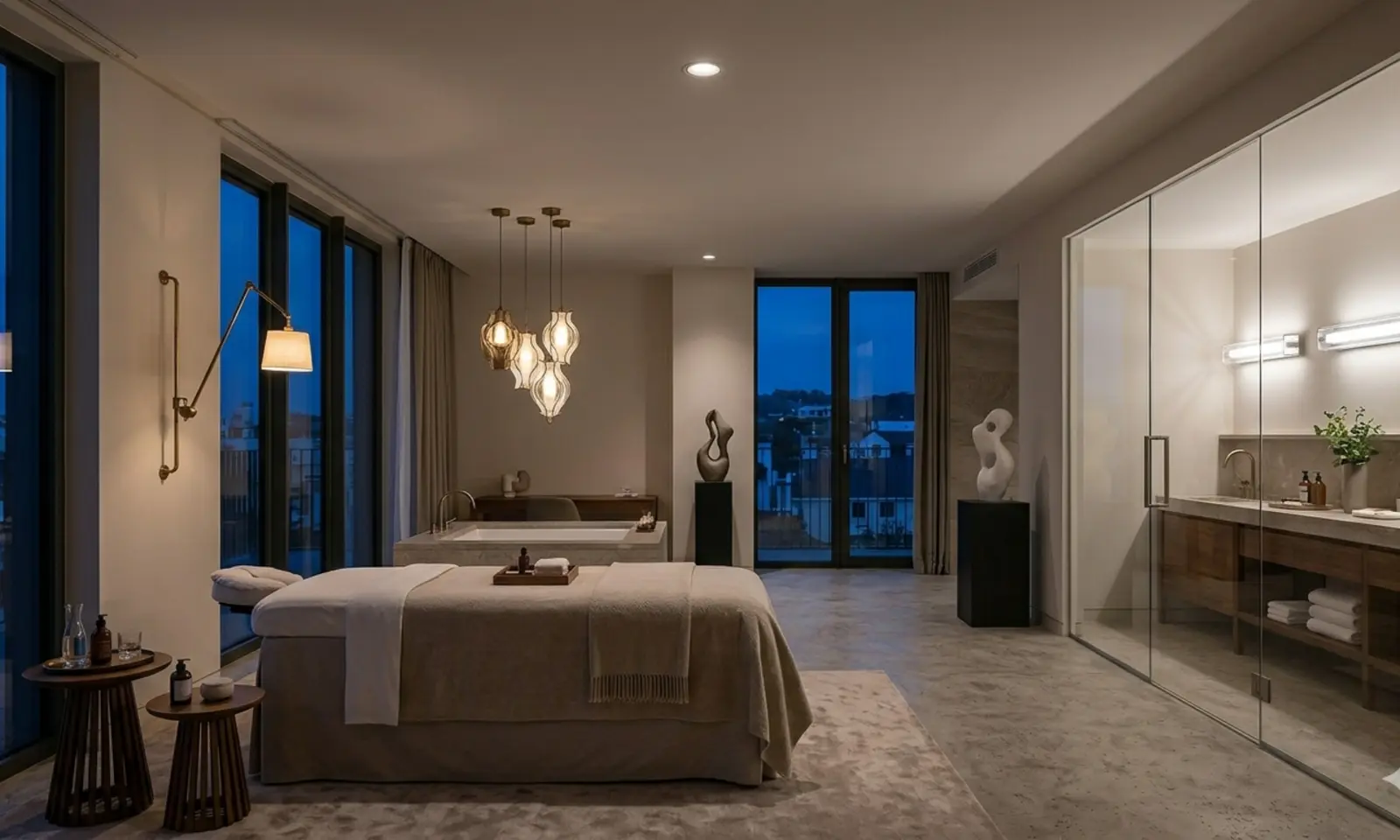
These are the heart of the spa experience. The lighting brief here should prioritise relaxation above all other considerations.
- Target 30โ80 lux overall ambient level โ significantly lower than any other hospitality space
- 2200โ2700K maximum โ warm amber, approaching candlelight
- No visible light sources above eye level when reclined โ recessed fixtures should be positioned so guests lying in rest beds or on heated loungers look at a dark ceiling, not at exposed sources
- Layered control โ the ability to dim independently by zone and time of day
- Transition lighting between wet and dry thermal areas to manage the psychological shift
Treatment Rooms
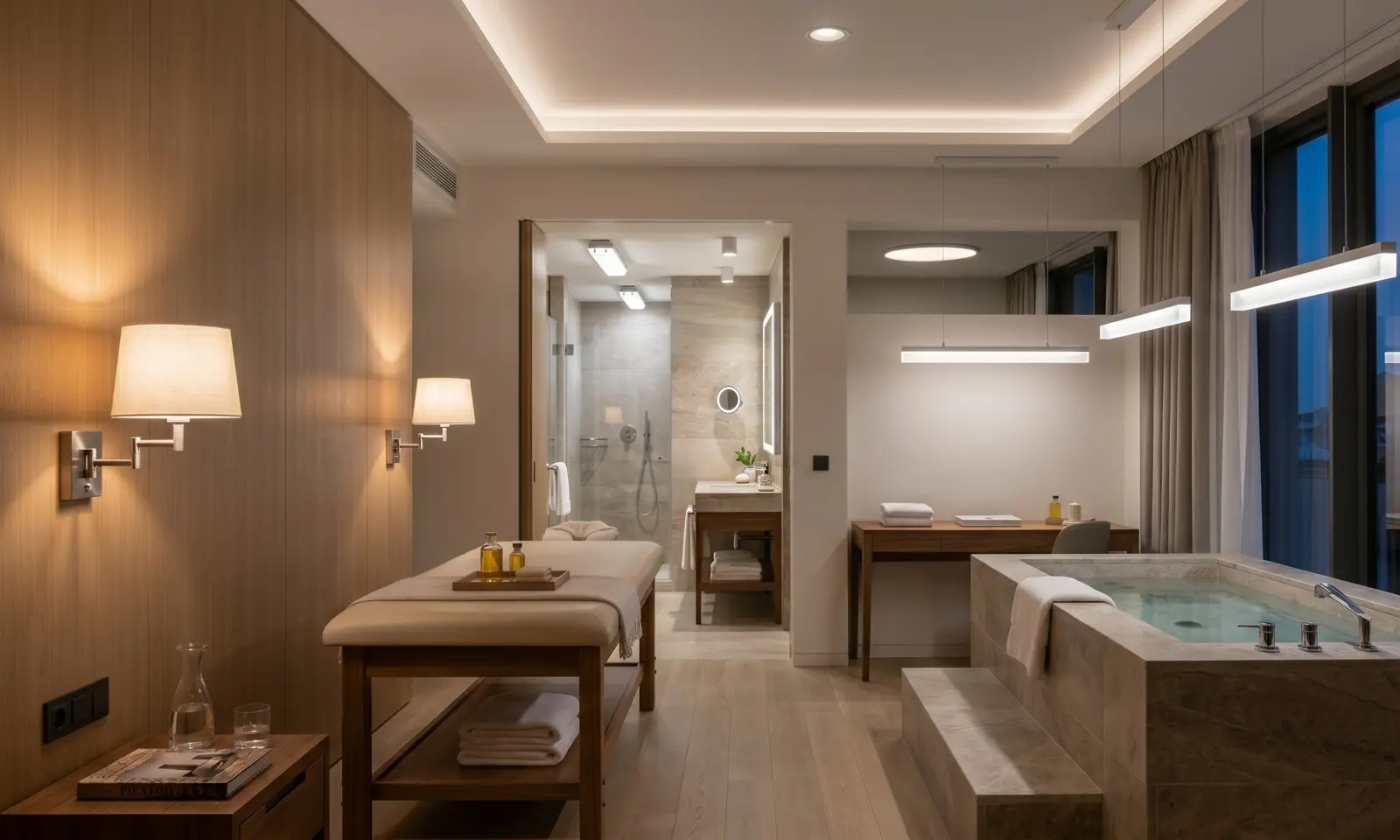
Treatment rooms have the most complex lighting requirement in a spa: therapists need adequate task light to work safely and effectively, while guests need to feel cocooned in near-darkness.
Solutions include:
- Independently switched circuits for therapist task lighting (higher output, cooler) and ambient guest lighting (very low, very warm)
- Ceiling fixtures positioned outside the guest's field of view when supine โ above the feet or behind the head
- Colour temperature range: 2200โ3000K, with the lower end preferred for ambient mode
- Dimmer control at therapist access โ not at the guest's position
Wet Areas and Hydrotherapy
IP ratings become critical in wet spa environments. All fixtures in wet areas must carry appropriate IP certification:
- IP44 minimum for enclosed wet areas (steam rooms, shower zones)
- IP65 for direct water spray zones (hydrotherapy jets, rain shower ceilings)
- IP68 for submerged or pool-adjacent installations
Beyond compliance, the aesthetic brief for wet areas should prioritise warm, enveloping light โ underwater LED systems in pools should be specified in warm white (2700โ3000K) rather than the cold blue often used in commercial pool settings.

Colour Temperature: A Decisive Parameter
The choice of colour temperature is the single most important lighting decision in spa design. The following recommendations should be treated as maximum values โ where possible, always specify toward the warmer end of each range.
Zone โ Recommended CCT โ Max CCT
Reception โ 2700K โ 3000K
Relaxation lounge โ 2200K โ 2700K
Treatment rooms (ambient) โ 2200K โ 2700K
Treatment rooms (task) โ 3000K โ 3500K
Changing rooms โ 2700K โ 3000K
Wet areas โ 2700K โ 3000K
Outdoor terraces โ 2200K โ 2700K
Dimming and Control Systems
All spa lighting should be fully dimmable, with a minimum dimming range of 100% to 1% (or dark). This allows the space to adapt across different treatment types, times of day, and guest preferences.
A spa lighting control system should include:
- Scene presets for common configurations (arrival, treatment, relaxation, cleaning)
- Therapist control at treatment room entry
- Manager override at reception for full-property adjustments
- Emergency lighting integration that does not compromise the atmosphere of non-emergency operation
Avoid systems where the emergency lighting layer produces bright, cold illumination in contrast to the spa's ambient scheme โ this is a common oversight with a jarring guest-experience impact.
Natural Light: Asset and Challenge
Natural light is a significant asset in spa design โ guests are drawn to it, it supports wellbeing, and it reduces artificial lighting energy consumption. However, it introduces challenges:
- Variable intensity and colour temperature across the day must be managed by artificial lighting to maintain consistent atmosphere
- Direct sun penetration can create glare and overheating in relaxation areas
- Blue-sky daylight (north-facing in the northern hemisphere) can be too cool for a wellness environment
Strategies:
- Use frosted, warm-tinted, or UV-filtering glazing to manage incoming daylight quality
- Position relaxation areas to receive indirect rather than direct daylight
- Design artificial lighting schemes to complement natural light at its warmest (morning and late afternoon) rather than competing with its brightest
๐ธ IMAGE ร AJOUTER : Spa relaxation lounge with filtered natural light and warm supplementary artificial lighting
The Designer's Sign-Off Checklist
Before approving a spa lighting specification:
- [ ] All zones specified at 2700K or below (treatment rooms maximum 3000K for task)
- [ ] Ambient lux levels confirmed: relaxation <80 lux, treatment ambient <50 lux
- [ ] No visible light sources above reclining guests in rest or treatment areas
- [ ] IP ratings confirmed for all wet zone fixtures (IP44 minimum, IP65 in spray zones)
- [ ] All circuits fully dimmable to minimum 1% output
- [ ] Control system includes scene presets for common configurations
- [ ] Emergency lighting integration reviewed for colour temperature compatibility
- [ ] Natural light management strategy confirmed (glazing spec, blinds, positioning)
- [ ] Colour rendering index confirmed: minimum CRI 90 across all areas
- [ ] Maintenance access confirmed for all ceiling and recessed fixtures in wet areas
"In a well-designed spa, guests are rarely aware of the lighting. They are only aware of how they feel. That invisibility is the standard to aim for."
Spa and wellness lighting is the discipline within hospitality where lighting's power to shape human experience is most directly legible. The investment in getting it right โ in specification, control, and detail โ is repaid in every guest who emerges from the space feeling genuinely restored.

About the Author
Lei
Production & International Projects Manager
20+ years of experience leading high-scale hospitality and public projects across USA, Europe, and GCC regions. Expert in custom manufacturing, quality assurance, and international logistics. Specialized in bridging design vision with production excellence for luxury luminaires.